AI and the future of work
How artificial intelligence is reshaping jobs, daily life, and the skills you need to thrive
In this lesson, you will read a journalistic article about artificial intelligence and its growing impact on the workplace and everyday life. You will explore 20 key B2-level vocabulary items, practise your reading comprehension, and respond to thought-provoking discussion questions. Grammar, preposition, and homework tasks will help you consolidate and apply what you have learned.
Vocabulary
Click each card to flip it and explore the full definition, example, and synonym.
The ability of computer systems to perform tasks that normally require human intelligence, such as learning, reasoning, and problem-solving.
"Artificial intelligence is being used to detect diseases earlier than human doctors can."
machine intelligence, AI, machine learning
To identify the nature of an illness, problem, or fault by examining symptoms or characteristics.
"Doctors can now use AI software to diagnose certain cancers from scan images."
identify, detect, determine
A thorough or dramatic change in form, appearance, nature, or character.
"The transformation of the publishing industry due to digital technology took less than a decade."
change, revolution, overhaul
Characterised by frequent repetition of the same action or element; tediously similar from one occasion to the next.
"Factory workers often perform repetitive tasks that robots can now do more efficiently."
monotonous, routine, mechanical
Operated or controlled by machines or computers, with little or no human involvement.
"The warehouse is almost fully automated — only a few human supervisors remain."
mechanised, computerised, robotic
A set of rules or step-by-step instructions followed by a computer to solve a problem or complete a task.
"The recommendation algorithm learned my preferences and now suggests films I actually enjoy."
procedure, formula, program
A person or thing that has the same function or characteristics as another in a different place or situation.
"The British minister met with her French counterpart to discuss trade policy."
equivalent, parallel, match
The quality of being able to adjust to new conditions or circumstances quickly and effectively.
"In a rapidly changing job market, adaptability is more valuable than any single skill."
flexibility, versatility, resilience
A major disturbance or interruption to an established system, market, or process, often caused by new technology or events.
"The disruption caused by streaming services destroyed the DVD rental industry almost overnight."
upheaval, disturbance, interference
An earlier event or action that serves as an example or guide to be considered in similar future situations.
"The court's ruling set a legal precedent that affected thousands of similar cases."
example, model, benchmark
To force someone or something out of their usual place or position, often by taking their role or replacing them.
"Many truck drivers fear they will be displaced by self-driving vehicles within a decade."
replace, oust, supplant
Causing anxiety, discomfort, or a sense of unease; slightly disturbing or worrying.
"It was unsettling to discover that the app had been tracking my location for months."
disturbing, disquieting, troubling
Firmly and deeply fixed in a surrounding mass or environment; fully integrated into something so it is hard to remove.
"Surveillance cameras have become so embedded in city life that most people no longer notice them."
integrated, ingrained, built-in
To become or make more intense, stronger, or more extreme in degree or force.
"Public debate about data privacy has intensified since the new facial recognition law was passed."
increase, strengthen, escalate
A person or official body that supervises a particular industry or activity and ensures rules and standards are followed.
"Financial regulators fined the bank for failing to protect customer data."
supervisor, authority, watchdog
The quality of being worthy of attention; importance, meaning, or consequence.
"The significance of the discovery was not fully understood until years later."
importance, meaning, weight
To find one's way through a complex or difficult situation or environment; to steer through challenges successfully.
"New graduates must learn to navigate a job market that is changing faster than ever before."
manage, steer, find one's way
A person who shares a flat or apartment with others but is not a family member.
"My flatmate works night shifts, so we rarely see each other during the week."
housemate, roommate, co-resident
A computer program designed to simulate conversation with human users, especially over the internet or via messaging apps.
"The company replaced its phone helpline with a chatbot that answers questions instantly."
virtual assistant, conversational agent, bot
A suggestion or proposal as to the best course of action; an endorsement of something as being good or suitable.
"The algorithm's recommendation was so accurate that I bought the book within minutes."
suggestion, advice, proposal
Reading
Read the article and explore the highlighted vocabulary. Use the controls to listen as you read.
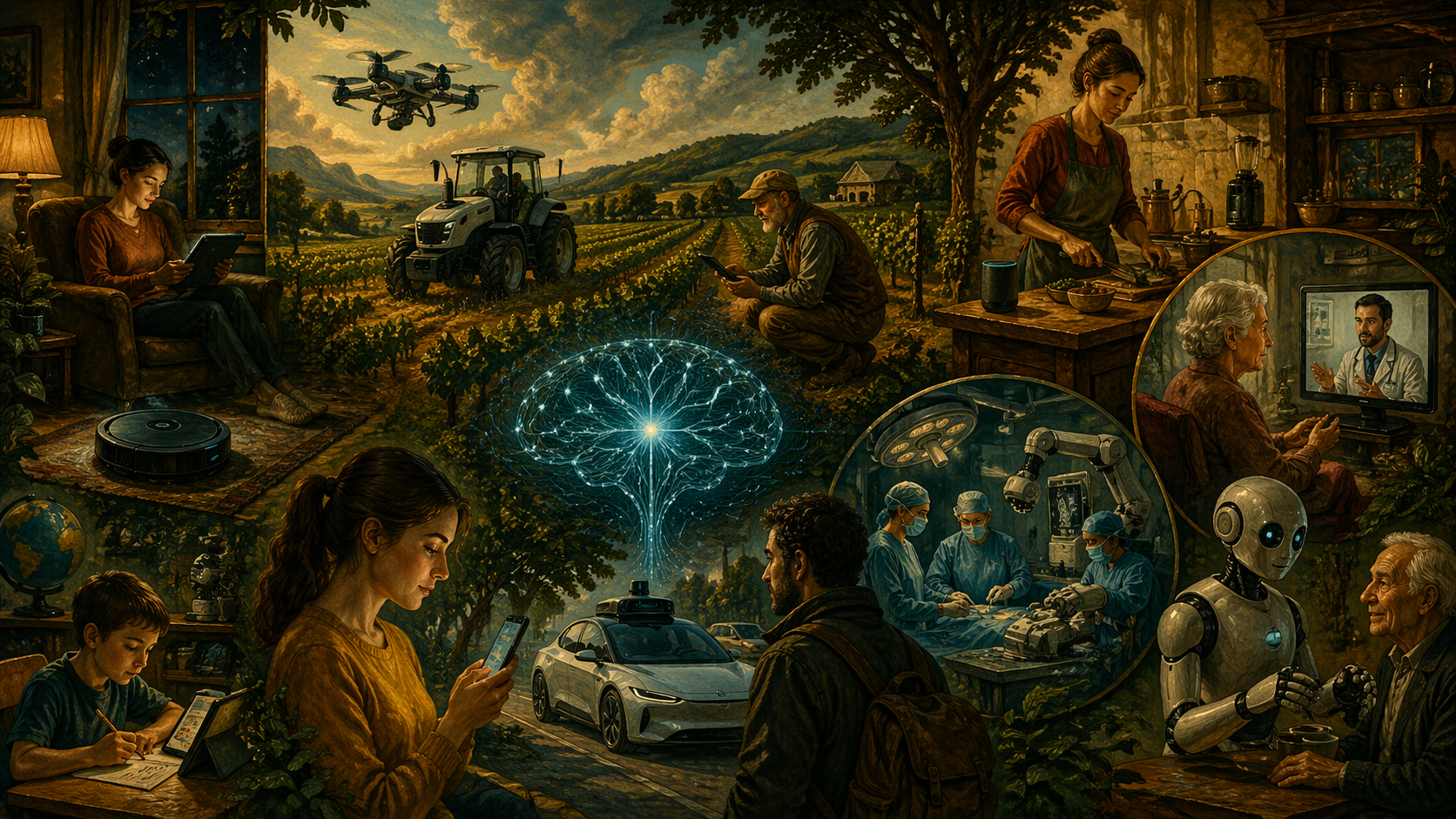
Not long ago, the idea of a machine writing your emails, diagnosingto identify an illness or problem your illness, or driving you to work belonged firmly in the realm of science fiction. Today, artificial intelligencecomputer systems that think like humans has quietly moved in — like a very efficient flatmatesomeone you share a home with who never leaves dishes in the sink. From customer service chatbotscomputer programs that chat like people to medical imaging software, AI is no longer a distant promise but a daily reality for millions of people around the world.
The workplace has been one of the most dramatic arenas for this transformationa thorough and dramatic change. Repetitivethe same thing done again and again tasks that once consumed hours of human effort are now being automateddone by machines, not people at remarkable speed. Data entry, scheduling, and even basic legal research have been taken over by algorithmssets of computer instructions that work faster and, arguably, more accurately than their human counterpartspeople doing the same job elsewhere. Entire industries are being reshaped, and workers are finding that adaptabilitythe ability to change easily has become the most valuable professional skill of the twenty-first century.
Not all the news is alarming, however. While some jobs have disappeared, new roles have emerged that simply did not exist a decade ago — prompt engineers, AI trainers, and data ethicists among them. Economists argue that technological disruptiona big change that causes disorder has always created more jobs than it destroys, pointing to the industrial revolution as a reassuring precedentan earlier example to follow. The challenge, of course, is that the workers displacedpushed out of their jobs by one wave of change are rarely the same people who ride the next one.
Beyond the office, AI has begun to reshape daily life in ways both convenient and quietly unsettlingslightly worrying or disturbing. Recommendationa suggestion of something good algorithms decide what we watch, read, and buy; facial recognition software unlocks our phones in milliseconds; and smart home devices have made it perfectly normal to argue with a cylinder in your kitchen. Privacy concerns have intensifiedbecome stronger or more extreme as the technology becomes more embeddeddeeply fixed and built into something in everyday existence, prompting governments and regulatorsofficials who enforce rules around the world to act.
For language learners, this technological revolution carries particular significanceimportance and meaning. Many of the fastest-growing careers require strong communication skills in English — from collaborating with international teams to interpreting AI-generated reports. Understanding how these changes are unfolding is not merely academic; it is increasingly essential for navigatingfinding your way through challenges the world of work that awaits you.
Discussion
Think carefully and write your answers. Click Model Answer only after the learner has attempted the question.
Vocabulary Check
Choose the best answer for each question.
1. Which word means "a set of computer instructions used to solve a problem"?
2. The factory workers were ___ by robots — they lost their jobs.
3. Her ___ in the Paris office does exactly the same job as she does in London.
4. The spread of AI caused a major ___ in the publishing industry.
5. Which adjective describes a task done the same way, over and over again?
6. The doctor was able to ___ the illness quickly using new AI software.
7. The industrial revolution is used as a ___ to show that technology creates jobs.
8. AI is now deeply ___ in everyday life — it is almost impossible to avoid.
9. The government asked ___ to investigate the company's use of personal data.
10. Her ability to learn new software quickly showed great ___.
11. Privacy concerns have ___ since the new facial recognition law was introduced.
12. The ___ of the AI revolution for language learners is enormous.
13. Young workers need to ___ a job market that changes very quickly.
14. The company replaced its phone helpline with a ___ that answers questions online.
15. The streaming platform's ___ suggested ten films I had never heard of but loved.
Grammar Practice
Complete each task. Use Grammar Focus when support is needed, then click Answers + Why to check.
Structure: have/has been + past participle
Rule: Use the passive when the receiver of the action is more important than the person or thing doing it.
Example: Many routine tasks have been automated by AI.
Why: The original sentence uses the present perfect. In the passive, keep have and add been + past participle.
Structure: has/have + past participle
Rule: Use the present perfect for a change that happened over time and remains true now.
Example: Digital literacy has become essential.
Why: Adaptability is singular, so use has. The change has developed over time and is still true now.
Structure: noun + comma + which + clause + comma
Rule: Use a non-defining relative clause to add extra information about a noun that is already clear.
Example: AI, which is developing rapidly, affects many industries.
Why: Which adds extra information about AI, so commas are required.
Structure: if + past simple, would + base verb
Rule: Use the second conditional for an imagined or unlikely present or future situation.
Example: If machines did every job, people would need a new source of income.
Why: The situation is hypothetical, so use past simple after if and would + base verb in the result.
Structure: said that + backshifted tense
Rule: After a past reporting verb, will normally changes to would. Present simple may also move back to past simple.
Example: She said that technology would change the industry.
Why: Will changes to would, and destroys is backshifted to destroyed.
Rule: Use however, nevertheless, on the other hand, or at the same time to contrast two complete ideas.
Example: Some roles disappeared. However, new careers emerged.
Why: The second sentence contrasts job losses with the creation of new roles.
Prepositions
Choose the correct preposition. Use Grammar Focus to review the collocation, then click Answers + Why.
1. AI has moved ___ our daily lives in a very short time.
Rule: Use move into for entering a new area, environment, or part of life.
Example: AI has moved into healthcare and education.
Why: The fixed phrase is move into an area or part of life.
2. Workers must adapt ___ rapid technological change.
Rule: Use adapt to when someone changes their behaviour or skills because of a new situation.
Example: Employees must adapt to new software.
Why: The standard verb-preposition combination is adapt to something.
3. Many employees are concerned ___ being displaced by automation.
Rule: Use concerned about + noun or -ing form to describe worry.
Example: Workers are concerned about losing their jobs.
Why: The fixed adjective-preposition phrase is concerned about.
4. Governments are responsible ___ regulating the use of AI.
Rule: Use responsible for + noun or -ing form to identify a duty.
Example: Regulators are responsible for protecting personal data.
Why: The fixed collocation is responsible for doing something.
5. AI can contribute ___ greater efficiency in the workplace.
Rule: Use contribute to when something helps cause or improve a result.
Example: Automation contributes to faster production.
Why: The correct collocation is contribute to a result.
6. Companies are investing heavily ___ AI training and development.
Rule: Use invest in for money, time, or effort directed toward a project or skill.
Example: Businesses are investing in employee training.
Why: The standard verb-preposition combination is invest in something.
Homework
Complete these tasks after class. Use a dictionary if needed.
Finish the Sentence
Complete each sentence logically and grammatically. Use Grammar Focus when needed.
Rule: Use which after a comma to comment on the whole previous idea.
Example: AI is used everywhere, which means people interact with it daily.
Why: The completion explains the result of AI entering daily life and fits after which means.
Rule: Use because + subject + verb to give a reason.
Example: Adaptability matters because technology changes quickly.
Why: The clause gives a direct reason for the importance of adaptability.
Rule: Use although + clause to introduce a contrast. The main clause must contain a complete contrasting idea.
Example: Although some roles disappeared, new jobs were created.
Why: The new roles contrast with the loss or automation of older jobs.
Rule: Use present perfect in the main clause and past simple after since for the event that started the period.
Example: Concerns have increased since facial recognition was introduced.
Why: The past event after since marks the starting point of an ongoing present situation.
Rule: A gerund phrase such as understanding AI can act as the subject. Use because to explain why it matters.
Example: Learning English is useful because many jobs require it.
Why: The completion provides a clear reason and agrees with the singular subject understanding AI.
Structure: is used + to-infinitive + that-clause
Rule: Use the passive when the example or evidence is more important than the person using it.
Example: History is used to argue that change can create opportunity.
Why: The that-clause clearly states the argument supported by the precedent.
Tenses
Write the verb in brackets in the correct tense. Use Grammar Focus before checking Answers + Why.
Structure: will have + past participle
Rule: Use the future perfect for an action expected to be complete before a future time.
Example: By 2030, many companies will have automated routine tasks.
Why: By 2030 sets a future deadline, so the action is viewed as complete before that point.
Structure: am/is/are + verb-ing
Rule: Use it for an activity happening now or around the present period.
Example: Governments are reviewing new AI laws.
Why: At the moment signals a current temporary activity, and regulators is plural.
Structure: had + past participle
Rule: Use the past perfect for an action or state that happened before another past action.
Example: AI tools had existed before they became mainstream.
Why: The existence of chatbots happened before the later past event became widely used.
Structure: if + present simple, modal + base verb
Rule: Use the present simple in the if-clause for a realistic future possibility.
Example: If companies do not train workers, skills gaps may grow.
Why: The if-clause takes present simple, while could rise expresses a possible result.
Structure: had + past participle
Rule: Use it for repeated actions completed before another past event.
Example: The system had suggested the film several times before I watched it.
Why: The recommendations happened before the later past event I finally watched it.
Structure: was/were + past participle
Rule: Use past simple after since for the completed event that began the period. Use the passive because the law receives the action.
Example: Since the regulation was introduced, companies have changed their policies.
Why: The law received the action, so passive voice is needed. The event is a completed past starting point after since.
Vocabulary in Context
Choose the correct word from the box to complete each sentence.
1. The streaming platform's ___ suggested ten films I had never heard of but loved.
2. The sudden ___ caused by AI forced many workers to retrain quickly.
3. This case will set a ___ for how courts deal with AI-related lawsuits in future.
4. Technology ___ have warned companies to be more transparent about how they use data.
5. It can be hard to ___ the complex rules and expectations of a new industry.
6. AI is now so deeply ___ in our phones that we use it without thinking about it.